
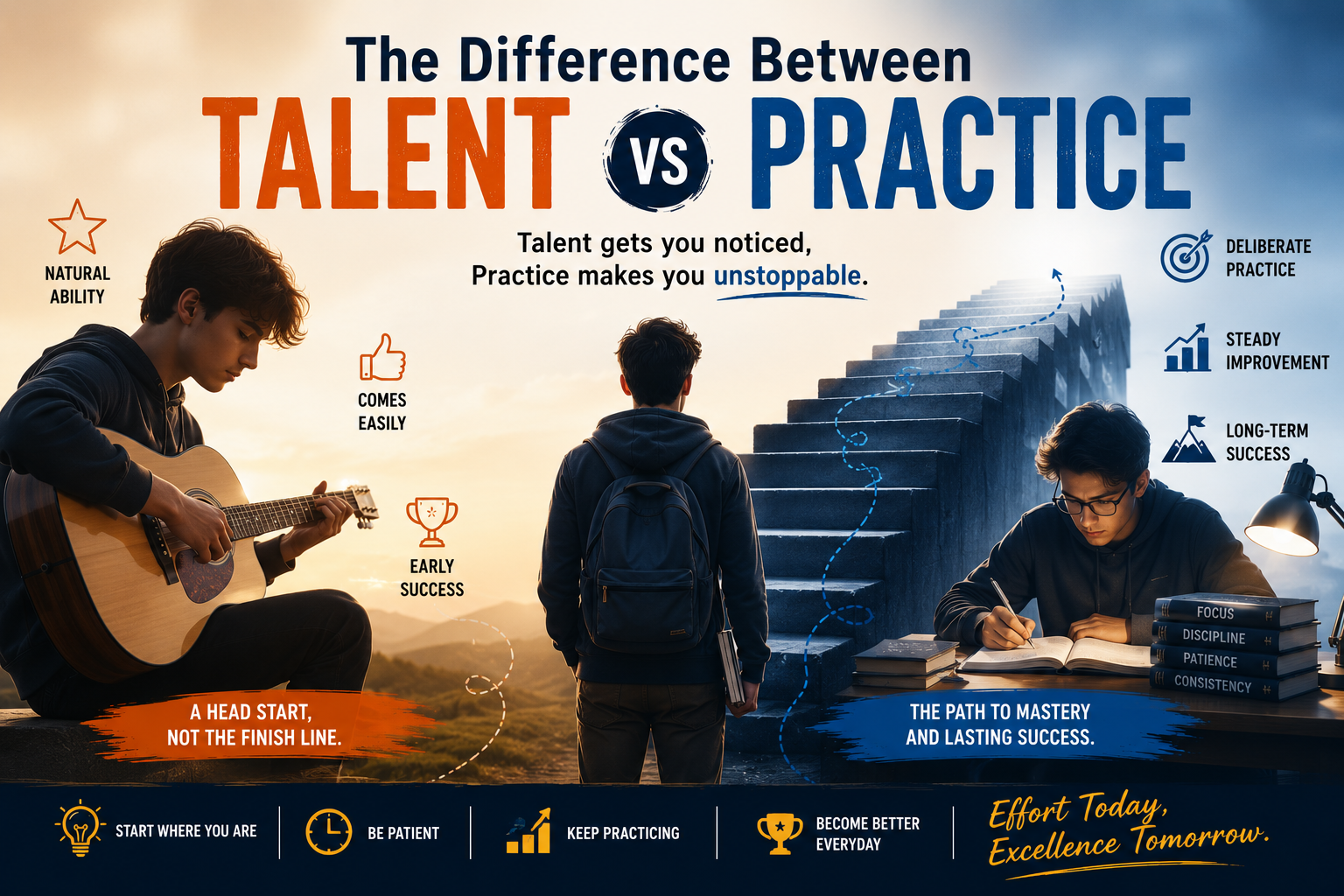
Talent is often described as a natural ability— the thing someone seems to be able to do effortlessly while others struggle to learn it. We see a student who understands mathematics quickly, a musician who seems naturally gifted, an athlete who performs with confidence, or an artist who creates beautiful work and immediately assume that talent is the reason behind their success. But talent is only one part of the story. Behind almost every impressive achievement is something less visible but equally powerful: practice. The difference between talent and practice is not simply about what you are born with versus what you learn. It is about potential versus development. Talent may give someone a starting advantage, but practice determines how far that ability can grow. A naturally talented person may learn something faster in the beginning, but without consistent effort, that early advantage can disappear. Meanwhile, someone who starts with average ability but continues learning, practicing, making mistakes, and improving can eventually surpass someone who relied only on natural talent. This is why students should be careful about labeling themselves as either "talented" or "not talented." Such labels can become limiting beliefs. A student who believes, "I'm not good at mathematics," may stop trying after a few difficult problems. Another student who believes, "I'm naturally good at everything," may avoid challenging situations because they are afraid of failing. Both mindsets can prevent growth. Practice changes this equation because it turns ability into skill. Reading about a subject can give you knowledge, but applying that knowledge repeatedly develops competence. Watching someone play an instrument can inspire you, but playing it yourself develops coordination. Understanding communication techniques can teach you the theory, but having conversations, giving presentations, and learning from mistakes develops confidence. Practice creates the connection between knowing something and being able to do it well. However, practice does not simply mean repeating the same activity again and again. Effective practice involves attention, feedback, correction, and gradual improvement. If you repeatedly make the same mistake without understanding it, repetition alone may not produce meaningful progress. Good practice means identifying what needs improvement, working on it intentionally, receiving feedback, and trying again. This is why a person who practices thoughtfully for a shorter period may improve more than someone who practices for many hours without focus. Another important difference between talent and practice is consistency. Talent can create an impressive first impression, but consistency creates lasting progress. You may not notice significant improvement after one day of practice, but small improvements accumulated over weeks, months, and years can create remarkable results. A student who reads a few pages every day can eventually develop a strong knowledge base. Someone who practices public speaking regularly can become more confident over time. A person who learns a new digital skill consistently can eventually turn that skill into a career opportunity. Progress is often less about dramatic transformation and more about what you repeatedly do. Practice also teaches something that talent alone cannot: resilience. When you practice, you make mistakes. You experience frustration. Sometimes you fail despite your effort. These moments teach you how to respond when things do not go according to plan. Instead of seeing mistakes as proof that you are incapable, you begin to see them as information about what you need to improve. This ability to learn from failure becomes extremely valuable in education, careers, relationships, and life. Talent can sometimes create the illusion that success should come easily. When talented individuals encounter something difficult for the first time, they may become discouraged because they are not accustomed to struggling. On the other hand, people who have developed through consistent practice often understand that difficulty is part of learning. They are more willing to stay with a problem, experiment with different approaches, and try again. This is one reason persistence can become more valuable than natural ability over the long term. For students, understanding the difference between talent and practice can completely change the way they approach education. Instead of asking, "Am I naturally good at this?" they can ask, "What can I improve with practice?" This simple change in thinking can make learning more empowering. Not understanding a concept today does not mean you will never understand it. Not being confident at public speaking does not mean you cannot become a good speaker. Not knowing how to code, design, write, lead, or communicate today does not determine what you will be capable of tomorrow. Skills can be developed. Practice is especially important in today's rapidly changing career landscape. Many of the skills that employers value can be learned and strengthened over time, including communication, problem-solving, leadership, digital literacy, creativity, critical thinking, teamwork, and adaptability. You do not need to be naturally exceptional at all of these skills. What matters is your willingness to learn and improve. In fact, one of the most valuable qualities in a professional may be the ability to become better at something over time. This is also why comparing your abilities with someone else's can be misleading. You may see someone's finished performance without seeing the years of practice behind it. Social media makes this problem even greater because we often see the achievements of others without seeing their failures, doubts, mistakes, and long hours of preparation. Instead of comparing your beginning with someone else's progress, focus on your own development. Ask yourself whether you are better today than you were yesterday, last month, or last year. Talent and practice should not be viewed as opposites. Talent can make learning easier in certain areas, while practice transforms that potential into reliable ability. The most successful people often combine natural strengths with discipline, curiosity, feedback, and continuous learning. They recognize what they are naturally good at, but they do not depend entirely on it. They keep developing. Ultimately, talent may open the first door, but practice determines how far you can travel after entering. You may not always be the most naturally gifted person in the room, and that is okay. What matters is your willingness to keep learning when something feels difficult, to practice when nobody is watching, and to continue improving when progress feels slow. Your starting point does not have to determine your destination. With consistent effort, thoughtful practice, patience, and the courage to learn from mistakes, an ability can become a skill, a skill can become expertise, and expertise can create opportunities. So instead of asking yourself, "Do I have enough talent?" ask a more powerful question: "What could I become if I practiced consistently?" The answer may surprise you.